Diligence pack
Investors, auditors and acquirers ask for the same equity records every time. The diligence pack puts your cap table, compliance reports and ledger audit trail in one zip, with a manifest that lists a SHA-256 fingerprint for every file. Download it from the Diligence pack button on your cap table.
Download the pack
On your cap table, click Diligence pack in the header. Tenacap builds the zip from your live records at that moment and downloads it as diligence-pack-<company id>-<date>.zip. Building a pack takes the Editor or Admin role, and every download is recorded as an export in your audit trail.

What’s in the pack
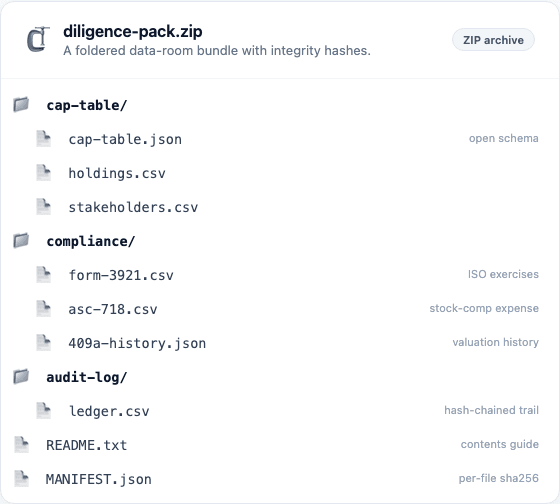
Three folders, a README and a manifest:
- cap-table/: the full open-schema export (
cap-table.json), plusholdings.csvandstakeholders.csvfor spreadsheet users. The JSON is built to the public Apache-2.0 schema. - compliance/:
form-3921.csv, the ASC 718 stock-comp CSV, and409a-history.jsonwith every valuation’s date, FMV per share, method, status and expiry. - audit-log/:
ledger.csv, up to the 2,000 most recent entries of the hash-chained ledger audit trail. The change log shows the full history.
The manifest & fingerprints
MANIFEST.json lists every other file in the pack with its size and SHA-256 hash, and records when the pack was generated and whether it includes personal data.
A recipient can hash each file and compare it with the manifest to confirm it arrived intact. The manifest travels inside the same zip and is not signed, so it cannot prove that nobody edited both a file and its entry. For that assurance, send the manifest’s own hash to the recipient through a separate channel.
Who sees personal data
Stakeholders’ tax IDs and addresses are decrypted and included only when a workspace admin builds the pack while signed in. That is the same rule as the plain export. An editor’s pack leaves those fields blank. A pack requested by a connected assistant or API token never includes them, whatever the role of the person behind the token, and also drops the IP addresses from the audit-log file. The manifest records which kind you produced.
When to send it
- A priced round. Investors’ counsel will ask for the cap table and compliance records. If you modeled the round in scenario modeling, the pack is the matching set of source records.
- An audit or tax filing. The compliance folder holds the Form 3921, ASC 718 and 409A records your accountant asks for.
- An acquisition. The pack answers the equity section of a buyer’s checklist; the buyer will still ask for signed documents, board consents and your charter.
For day-to-day work, the lighter export & open schema gives you the cap table alone in JSON, CSV or a small zip.